Yiwu Market, officially known as Yiwu International Trade City, is divided into 6 districts, each specializing in different product categories, from toys and hardware to fashion accessories and imported goods. Thousands of sellers work here year-round, drawing buyers from well over a hundred countries who come for low prices and constant product variety.
This guide breaks down how the district system works, what each district sells, and how to move through them efficiently when planning a sourcing trip. For a broader overview of the entire market, visit our complete Yiwu market guide.
Yiwu Market Districts at a Glance
Yiwu Market, officially known as Yiwu International Trade City, is divided into 6 districts, each specializing in different product categories. Understanding each district’s focus helps buyers quickly locate suppliers and plan their sourcing route inside the market.
| District | Best For |
|---|---|
| District 1 | Toys, artificial flowers, jewelry, accessories |
| District 2 | Bags, hardware, umbrellas, tools |
| District 3 | Cosmetics, stationery, office and sports goods |
| District 4 | Tools, electronics, machinery parts, textiles |
| District 5 | Imported goods, home textiles, food |
| District 6 | Fashion jewelry, smart devices, cross-border e-commerce trend goods, beauty, baby products |
Overview of Yiwu Market Districts (1 to 6)
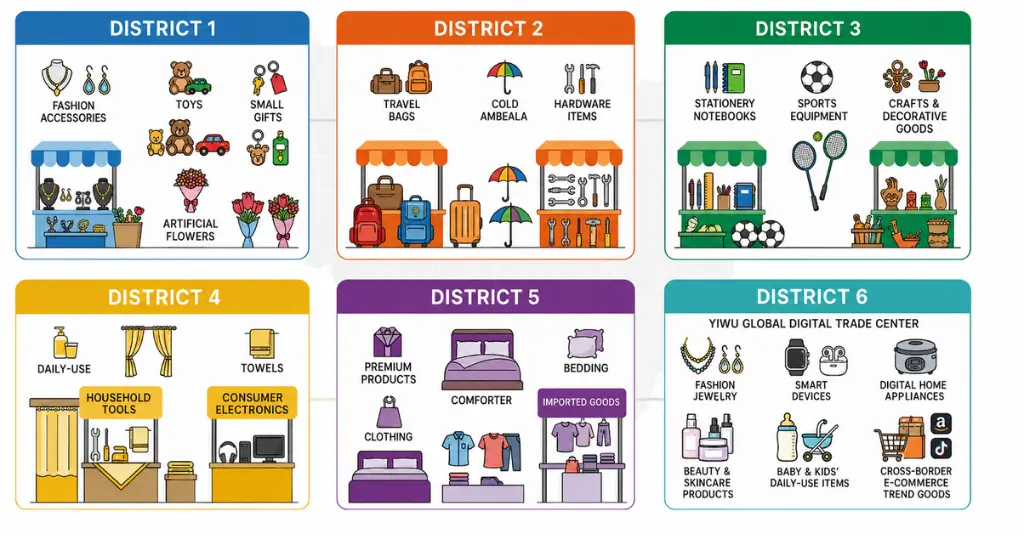
Start by getting clear on Yiwu’s layout. It shapes every buying decision. Knowing which district carries your product makes Yiwu product sourcing faster and more accurate from day one. This huge marketplace splits into six zones, something nearly every guide mentions, whether it covers Yiwu International Trade City, general district layouts, or broad overviews of its Yiwu wholesale market districts.
District 1 Overview
Inside Yiwu market district 1, you will find rows of stalls selling trinkets that hang, clip, or tie onto things. Moving further in, small colorful playthings for children fill shelves from floor to ceiling. Fake blossoms made from fabric and plastic sit bundled together near the back alleys. This district is usually where new buyers start, since the products here are small, low-cost to sample, and easy to mix into a single order.
- Products: Toys, jewelry, artificial flowers, decorative accessories
- Best For: Gift shops, novelty retailers, and first-time buyers
District 2 Overview
Yiwu market district 2 includes bags, hardware, and umbrellas. You also find luggage, locks, tools, and rain gear. Many suppliers focus on practical, everyday products used in retail and wholesale markets. Buyers often come here for durable goods with steady demand rather than seasonal or trend items.
- Products: Bags, hardware, tools, umbrellas, rain gear
- Best For: Buyers sourcing durable, everyday retail goods
District 3 Overview
Out here, Yiwu market district 3 handles makeup items, paper goods, and also handmade stuff. It also includes stationery, office supplies, and sports goods. This district attracts wholesalers who deal in bulk paper products. Craft and decorative items appear across multiple sections, drawing two fairly different buyer types under one roof.
- Products: Cosmetics, stationery, office supplies, sports goods
- Best For: Beauty retailers and school or office suppliers
District 4 Overview
Yiwu market district 4 focuses on tools, electronics, and machinery parts. You also find textiles, daily-use products, and electrical accessories. This district supports both industrial sourcing and high-volume household goods. Many buyers visit this section for consistent supply and product variety.
- Products: Tools, electronics, machinery parts, textiles
- Best For: Industrial sourcing and high-volume household goods
District 5 Overview
Goods brought in from abroad fill Yiwu market district 5, along with threads for wearing. Food finds its place there too, sitting beside bundles of fabric. Items not made locally settle into shelves next to meals ready to be eaten, a mix that’s fairly unusual for Yiwu since most other districts focus on locally manufactured products.
- Products: Imported goods, home textiles, food
- Best For: Lifestyle, bedding, and imported-product buyers
District 6 Overview
Yiwu market district 6, officially the Yiwu Global Digital Trade Center, opened in October 2025 as the newest addition to Yiwu International Trade City. It brings together fashion jewelry, smart devices, digital home appliances, beauty and skincare products, and baby and kids’ daily-use items, alongside trend products popular on cross-border platforms like Amazon and TikTok Shop. Because the category mix here shifts faster than in the older districts, it’s worth checking again on each visit rather than assuming last year’s product list still applies.
- Products: Fashion jewelry, smart devices, digital home appliances, beauty and baby products, cross-border e-commerce trend goods
- Best For: Cross-border e-commerce sellers and trend-driven or private-label brands
Why the District System Matters
Yiwu’s marketplace is large enough that finding the right supplier by chance isn’t realistic. The United Nations Conference on Trade and Development has pointed to Yiwu as one of the world’s leading hubs for small commodity trade, and that scale is exactly why the district structure exists: without it, buyers would have no way to narrow down where a specific product category is sold.
Each district focuses on a distinct set of goods, so a buyer who doesn’t know the layout in advance typically ends up circling back through zones they’ve already covered, losing hours that could have gone toward actual supplier meetings. Reviewing the district breakdown before arriving, rather than figuring it out on the ground, is what separates a focused sourcing trip from one that runs long and covers less ground than planned.
For a more detailed breakdown of each district and how to navigate the market layout, refer to our dedicated map and layout guide on the Kingsler Yiwu guide page.
Not sure where to start in Yiwu Market? Talk to a sourcing specialist from Kingsler today and get expert guidance before you even set foot in the market.
How to Choose the Right District
Which district to prioritize depends on three things: what you’re sourcing, how much you’re planning to order, and what kind of supplier relationship suits your business. Getting this decision right before you arrive saves time on the ground, since each district specializes in different goods and moving between unrelated zones eats into the hours you have for actual supplier meetings. For help planning transport and accommodation around the right zones, our Yiwu city guide covers that separately.
Based on Product Category
The most direct way to choose is to match your product to a district’s specialty, using the district breakdown above as a reference. Buyers sourcing across several unrelated categories usually need to plan a route through two or three districts rather than settling on one, so it’s worth mapping your product list against those districts before you go.
Based on Budget and MOQ
MOQ and per-unit pricing vary not just between districts but between individual suppliers within the same district. Some stalls accept small trial orders, while others are built around bulk production and won’t engage below a certain quantity. Buyers working with a tighter budget or a smaller test order should confirm MOQ requirements before committing to a supplier meeting, since assuming standard terms upfront can lead to wasted visits.
Based on Supplier Type
Manufacturers typically offer better per-unit pricing on larger, consistent orders but less flexibility for custom requests, while trading companies and middlemen can source across multiple categories and accommodate smaller or mixed orders, usually at a slight markup. Knowing which type you’re dealing with before negotiating shapes how much room you actually have to push on price and terms.
Once you’ve picked your districts and are ready to move through sampling, negotiation, and shipping, our Yiwu sourcing agent page covers that full process in detail, and a consolidation service can combine orders from multiple districts into one shipment.
Common Mistakes Buyers Make When Navigating Districts
Not every buyer gets what they expect from a district visit. Most repeat problems trace back to a handful of avoidable mistakes. These tend to show up at a few predictable points: verifying suppliers, reading order details, or handling paperwork.
- Skipping supplier verification. Rushing into a deal without checking a supplier’s track record is one of the fastest ways sourcing trips go wrong. A proper quality inspection before shipment catches issues before they cost you money.
- Working through unverified middlemen. Middlemen can shift how prices are set without warning, adding cost that wasn’t part of the original quote.
- Misreading order details. Details on specs, colors, or quantities get lost when communication with a supplier isn’t clear, leading to orders that don’t match what was agreed.
- Underestimating export paperwork. Documentation for international shipments can tangle quickly and slow everything down. A reliable China shipping logistics service keeps cargo movement and customs paperwork on track from Yiwu to your door.
- Skipping the district layout altogether. Buyers who walk in without knowing which district sells what tend to lose time circling back through zones they’ve already covered.
Tips to Navigate Yiwu Market Districts Efficiently
Yiwu’s districts are large enough that a plan matters more than instinct once you’re inside. A few practical habits make the difference between a rushed visit and a productive one. These are small adjustments, but they add up over a full day of sourcing.
- Plan your route before you arrive. Decide which one or two districts match your product priorities and map a route between them, rather than deciding on the ground.
- Start early in the day. Districts get busier as the morning goes on, and starting early gives you more time with suppliers before booths get crowded.
- Carry a physical or offline map. Signal inside the complex isn’t always reliable, and a saved map avoids losing time relying on a live connection.
- Photograph booth numbers as you go. With thousands of stalls per district, it’s easy to lose track of a supplier; you liked a quick photo of the booth number, and it saves a return trip.
- Group nearby districts on the same day. Districts 1 and 2, or 4 and 5, sit close enough that combining them in one day cuts down on repeat transport and check-in time.
None of these take much extra planning, but together they’re usually what separates buyers who leave with solid supplier contacts from those who spend most of the day getting oriented.
Role of a Yiwu Sourcing Agent
Working through thousands of stalls without local knowledge is where most sourcing trips lose time. Kingsler’s team is based in Yiwu and works across all six districts, and our role for buyers usually comes down to a few specific things:
- Vendor vetting. Instead of guessing which supplier to trust, we point buyers toward vendors with a verified track record.
- Price negotiation. Our team knows local pricing norms well enough to push back on quotes that are set higher for first-time or overseas buyers.
- Clear communication. Language and terminology gaps between buyer and supplier shrink when we’re relaying details on both sides.
- On-site quality checks. We verify product quality in person rather than relying on photos or a supplier’s own claims.
- Shipping coordination. We arrange export documentation and logistics ahead of time, which cuts down on delays once goods are ready to move.
Because our team works across Yiwu regularly, we’re familiar with all six districts, which is usually what helps clients avoid the costlier mistakes covered above. To see how Kingsler handles this end-to-end, from supplier selection through to delivery, visit our Product sourcing service page.
Yiwu Market Districts vs Online Sourcing
Yiwu vs. online marketplaces: Buying through Alibaba or similar platforms works well for standardized products where photos and specs tell the full story, but it leaves buyers relying on a supplier’s own listing for quality and accuracy. Visiting Yiwu in person removes that gap. Buyers handle samples directly, compare several sellers side by side within the same walk, and catch quality issues before placing an order rather than after receiving it.
Yiwu vs. trade shows: Compared with events like the Canton Fair, which runs only twice a year, Yiwu operates year-round, so timing a trip doesn’t depend on a fixed event calendar. Yiwu’s districts also work with smaller order volumes than most large trade shows are set up to handle, making it a more practical option for buyers testing a new product line rather than placing an immediate bulk order.
Final Takeaway
Yiwu’s market districts are larger than most first-time buyers expect, and the layout only starts to make sense once you’ve walked it. One wrong turn can land you in electronics when fabric was the goal, and walking into the wrong hall often leads to mismatched orders and wasted time. Knowing which of the six districts to prioritize before you arrive is what turns a confusing first visit into an efficient one.
China’s logistics network, ranked among the world’s strongest by the World Bank’s Logistics Performance Index, is part of why Yiwu works as a sourcing hub in the first place: goods move quickly from the market floor to ports and onward to buyers overseas. Pairing that infrastructure with a clear understanding of Yiwu’s district system is what lets buyers build supply chains that scale without the delays and mismatched orders that come from sourcing blind.
Start your sourcing journey with a Yiwu market expert. Let Kingsler help you navigate Yiwu market efficiently, avoid costly mistakes, and find the right suppliers for your business.
FAQs
How many districts are there in Yiwu Market?
What is Yiwu Market District 1 Known for?
What is Yiwu Market District 2 Known for?
What is Yiwu Market District 3 Known for?
What is Yiwu Market District 4 Known for?
What is Yiwu Market District 5 Known for?
What is Yiwu Market District 6 known for?
District 6, also called the Yiwu Global Digital Trade Center, is known for smart electronics, fashion jewelry and creative collectibles, digital home appliances, beauty and skincare products, and cross-border e-commerce trend items popular on platforms like Amazon and TikTok Shop.