
If you’re sourcing products from Yiwu, the world’s largest small commodities market, chances are you’re buying from more than one supplier. That’s where most importers quietly lose money. When each supplier ships separately, freight costs stack up fast, customs becomes a juggling act, and your profit margins take a hit before the goods even leave China.
Yiwu consolidation shipping solves this problem at its root. By combining goods from multiple suppliers into one outbound shipment, it dramatically cuts your total freight bill and simplifies your entire import process. Whether you’re a small e-commerce seller or a mid-sized importer, understanding how Yiwu consolidation shipping works and why it matters can be the difference between a profitable import cycle and a costly one.
What Is Yiwu Consolidation Shipping?
Yiwu consolidation shipping is a logistics process in which goods purchased from multiple suppliers in or around the Yiwu market are collected at a single warehouse, consolidated into a single shipment, and exported together, either as LCL (Less than Container Load) or FCL (Full Container Load), to reduce the total cost of international freight.
Instead of each supplier arranging their own shipment (and charging you freight separately), a consolidation agent or freight forwarder handles collection, storage, sorting, packing, and export as a unified operation.
According to the World Trade Organization, China remains the world’s largest goods exporter, and Yiwu is one of its most critical export hubs, making efficient consolidation logistics more important than ever for importers worldwide.
How It Works Simply
- Goods are collected from different suppliers across Yiwu and the surrounding factory regions
- Items arrive at a centralized Yiwu consolidation warehouse
- The warehouse team sorts, inspects, and repacks goods as needed
- Everything is loaded into a single container or LCL shipment
- The consolidated cargo is shipped internationally via sea or air freight
Why Consolidation Shipping Is Important in Yiwu
Yiwu’s trading model is built around variety. Most buyers don’t order from a single supplier; they source toys from one vendor, kitchenware from another, and accessories from a third. Without Yiwu consolidation shipping, each of those orders travels separately, generating separate freight charges, separate customs declarations, and separate handling fees.
Consolidation shipping is important because it reduces freight costs, simplifies logistics, and helps small and medium importers ship efficiently from multiple suppliers. It’s the backbone of how serious Yiwu importers manage their supply chain.
Kingsler’s Yiwu sourcing and shipping services are built around exactly this model, helping importers combine orders and move goods efficiently from the market floor to the destination port.
Key Benefits
- Lower per-unit shipping cost: shared container space means you pay for what you actually use
- Easier logistics management: one point of contact, one shipment, one set of documents
- Reduced customs complexity: a single consolidated shipment is simpler to clear than multiple small ones
- Better cash flow: fewer surprise fees and more predictable freight budgets
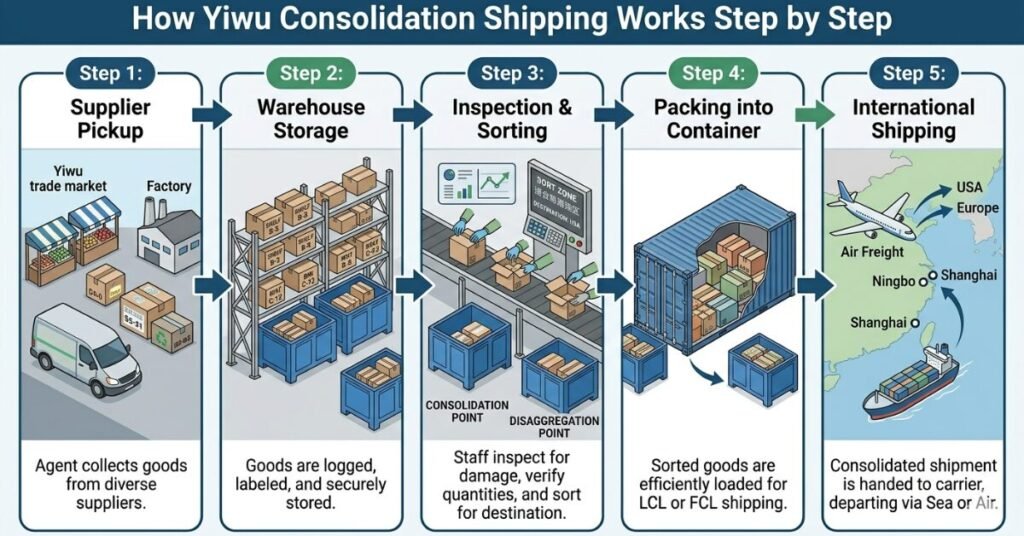
How Yiwu Consolidation Shipping Works Step by Step
Understanding the process helps you plan smarter and avoid delays. Here’s how Yiwu consolidation shipping flows from the supplier to the port.
Step 1: Supplier Pickup
Once you’ve confirmed your orders, the consolidation agent arranges collection from each supplier. Goods are picked up from factories or trade stalls across Yiwu and transported to the warehouse. This saves you the headache of coordinating delivery schedules with multiple vendors.
Step 2: Warehouse Storage
All goods are received at the Yiwu consolidation warehouse, where they’re logged, labeled, and stored until your full order is ready. Most reputable consolidation services offer flexible storage windows, so you’re not rushed to consolidate before all your goods have arrived.
Step 3: Inspection & Sorting
This is where Yiwu cargo consolidation service adds significant value. Warehouse staff conduct quantity checks, look for visible damage, and sort products by destination or category. Many providers also offer repacking and relabeling as part of this stage, which is especially useful for e-commerce sellers with specific packaging requirements.
Step 4: Packing into Container
Once all goods are verified and sorted, they’re loaded efficiently into a container. For smaller orders, this means LCL shipping, where your cargo shares space with other importers’ goods. For larger volumes, a dedicated FCL container may be more economical. Either way, groupage shipping from Yiwu ensures you’re not paying for air.
Step 5: International Shipping
The consolidated shipment is handed over to a freight carrier and departs from a major Chinese port, typically Ningbo or Shanghai via sea freight, or from Yiwu’s own cargo airport for air shipments. From here, consolidated shipping China to USA, Europe, or other destinations follows standard international freight timelines.
How Yiwu Consolidation Shipping Saves Money
The cost savings of Yiwu consolidation shipping are straightforward: when multiple small shipments become one larger shipment, every cost component shrinks proportionally, and some disappear entirely.
It saves money by combining multiple small shipments into one larger shipment, reducing per-unit freight and eliminating multiple shipping fees.
Cost Saving Factors
Importers who switch to consolidation shipping typically see savings across several areas. Here’s a breakdown of where the money stays in your pocket:
- Reduced LCL charges: LCL rates are calculated by CBM (cubic meter). Consolidating your goods means you negotiate or pay for one LCL slot rather than several separate bookings, each with its own minimum charges.
- Lower handling fees: Every shipment that moves through a port or freight terminal incurs handling fees. One consolidated shipment means one set of terminal handling charges (THC), not three or five separate ones.
- Shared container cost: When your volume justifies a full container, China consolidation shipping Yiwu market lets you split that cost across all your suppliers’ goods, bringing the per-unit freight rate down significantly.
- Reduced documentation fees: Each international shipment requires a bill of lading, a commercial invoice, a packing list, and a customs declaration. Consolidating shipments cuts your documentation overhead and the fees that come with it.
Yiwu Consolidation Shipping vs Direct Shipping
Not every situation calls for consolidation, but for most Yiwu importers, it’s the smarter default. Here’s how the two approaches compare:
| Factor | Direct Shipping | Yiwu Consolidation Shipping |
| Best for | Large, single-supplier orders | Multi-supplier, mixed-product orders |
| Freight cost | Higher per unit for small orders | Lower through shared container costs |
| Customs handling | Multiple declarations | Single consolidated declaration |
| Logistics complexity | High (coordinate each supplier) | Low (one agent manages all) |
| Lead time flexibility | Dependent on each supplier | Buffer time is built into the warehouse storage |
| Risk of loss/damage | Spread across shipments | Centralized inspection reduces risk |
Direct shipping may work well for large single-supplier orders, but Yiwu consolidation shipping is almost always more cost-effective for importers sourcing from multiple suppliers. The freight savings alone often cover the consolidation service fee, and the time saved managing logistics is a bonus on top.
When Should You Use Consolidation Shipping?
Yiwu consolidation shipping isn’t just for large-scale importers. It’s the right choice across a wide range of sourcing scenarios. If any of the following apply to your business, consolidation shipping is worth taking seriously:
- Multiple Supplier Orders: If you’re buying from two or more suppliers in Yiwu (or the surrounding region), consolidating is almost always cheaper than shipping separately. The more suppliers involved, the bigger the savings.
- Small Quantity Shipments: Ordering a few hundred units per product doesn’t justify a full container per supplier. Yiwu cargo consolidation service lets you fill a shared container and pay only for your portion.
- E-commerce Imports: Online sellers sourcing from Yiwu for Amazon FBA, Shopify, or other platforms often need mixed SKUs in manageable quantities. Consolidation keeps freight costs lean and lets you test new products without overcommitting to large orders.
- Mixed Product Categories: If your order includes electronics, apparel, toys, and home goods from different suppliers, a Yiwu warehouse consolidation service keeps everything organized, inspected, and packed together before export.
Ready to streamline your Yiwu imports? Contact Kingsler for professional consolidation shipping, warehouse support, and end-to-end logistics management from Yiwu to your door.
Common Mistakes Importers Make Without Consolidation
Many importers, especially those new to sourcing from Yiwu, make avoidable mistakes that cost them money and cause delays. This is exactly what Kingsler’s logistics team offers importers sourcing from the Yiwu market. Skipping Yiwu consolidation shipping in favour of ad-hoc arrangements is usually at the root of these problems:
- Shipping each supplier separately: This seems like the path of least resistance, but it quickly becomes the most expensive. Each shipment generates its own freight cost, documentation fee, and customs entry. Three suppliers shipping separately can cost two to three times more than one consolidated shipment.
- Overpaying freight costs: Without consolidation, importers routinely pay LCL minimums on small parcels that don’t come close to filling the minimum billable volume. China consolidation shipping Yiwu market eliminates this waste by combining volumes.
- Poor coordination between suppliers: When suppliers ship independently, goods arrive at different times, creating storage headaches at the destination and making inventory management unpredictable. A centralized Yiwu warehouse consolidation service keeps everything on one schedule.
- Customs inefficiencies: Multiple small shipments from the same buyer can attract additional scrutiny from customs authorities. According to U.S. Customs and Border Protection, consolidated commercial shipments with complete documentation clear faster and with fewer compliance issues than fragmented small entries.
Real Example: Cost Difference With and Without Consolidation
Let’s put some context around the numbers. Imagine you’re sourcing from three suppliers in Yiwu, one providing phone accessories, one providing travel bags, and one providing stationery products.
Without consolidation:
- Supplier A ships 0.5 CBM → pays LCL minimum charge (~$120–150)
- Supplier B ships 0.8 CBM → pays LCL minimum charge (~$120–150)
- Supplier C ships 0.4 CBM → pays LCL minimum charge (~$120–150)
- Total freight cost: ~$360–450, plus three sets of documentation fees
With Yiwu consolidation shipping:
- Total cargo: 1.7 CBM shipped as a single LCL booking
- LCL rate at 1.7 CBM → approximately $140–180 total
- One set of documents, one customs entry
- Net saving: $200–270 on freight alone
That’s a real, repeatable saving on every import cycle. Multiply that across quarterly or monthly shipments, and the impact on your annual logistics budget becomes significant.
Role of Yiwu Warehouses in Consolidation
The warehouse is the operational heart of Yiwu Consolidation Shipping. Without a reliable warehouse partner on the ground in Yiwu, consolidation simply doesn’t work at scale. Here’s what a quality Yiwu warehouse consolidation service should provide:
Storage Services: Flexible short and medium-term storage to accommodate staggered supplier deliveries. Your goods should be safe, organized, and accessible while you wait for the full order to arrive.
Quality Inspection: Basic quantity checks, carton condition inspection, and product verification before packing. This is your last line of defence before goods leave China, and a good Yiwu cargo consolidation service takes it seriously.
Repacking and Labeling: For e-commerce sellers, especially, the ability to repack goods into standardized cartons or apply FBA labels, barcodes, or custom stickers at the warehouse is a major operational advantage.
Export Documentation Handling: From commercial invoices to packing lists and certificates of origin, a professional groupage shipping from Yiwu provider handles all export paperwork, reducing the risk of documentation errors that delay clearance.
Final Thought
Yiwu consolidation shipping is no longer limited to large importers, it has become a practical and cost-effective solution for any buyer sourcing from multiple suppliers in Yiwu. By combining shipments into a single delivery, businesses reduce freight costs, avoid repeated documentation, simplify customs clearance, and gain stronger control over their supply chain. Shared container and LCL space help keep per-unit shipping competitive, while centralized inspection, packing, and coordination reduce delays, errors, and unnecessary logistics stress.
Smart importers use consolidation shipping to protect profit margins and scale operations without increasing shipping complexity. Whether you are placing your first order from Yiwu or improving an existing sourcing process, consolidation remains one of the most effective ways to optimize freight strategy.
Planning to import from Yiwu? Contact Kingsler for professional consolidation shipping, warehouse support, and logistics optimization tailored to your business.
FAQs
What is Yiwu consolidation shipping?
Yiwu consolidation shipping is a freight service where goods from multiple suppliers in Yiwu are collected at a warehouse, combined into one shipment, and exported together. It reduces the total cost of shipping by eliminating separate freight bookings and documentation for each supplier.
How does consolidation shipping save money?
It saves money by merging multiple small shipments into one, removing duplicate LCL minimums, cutting per-shipment handling and documentation fees, and allowing importers to share container costs. The savings are most pronounced when sourcing from three or more suppliers.
Is LCL consolidation cheaper than direct shipping?
For small and medium volume orders from multiple suppliers, yes, LCL consolidation is almost always cheaper than direct shipping from each supplier separately. Direct shipping makes more sense only for large single-supplier orders that can fill an entire container.
Can I combine products from different suppliers?
Yes. That’s exactly what Yiwu consolidation shipping is designed for. A Yiwu consolidation warehouse collects goods from as many suppliers as needed, inspects and sorts them, then packs everything into a single export shipment.
How long does consolidation shipping take?
The timeline depends on how quickly all suppliers deliver to the warehouse and your chosen shipping mode. Once all goods are received and consolidated, sea freight to the USA or Europe typically takes 25–35 days. Air freight via groupage shipping from Yiwu can reduce this to 5–10 days.
Do I need a warehouse in Yiwu for consolidation?
You don’t need to own a warehouse; you need access to one. A professional Yiwu cargo consolidation service or freight forwarder will provide warehouse facilities as part of their service package.