
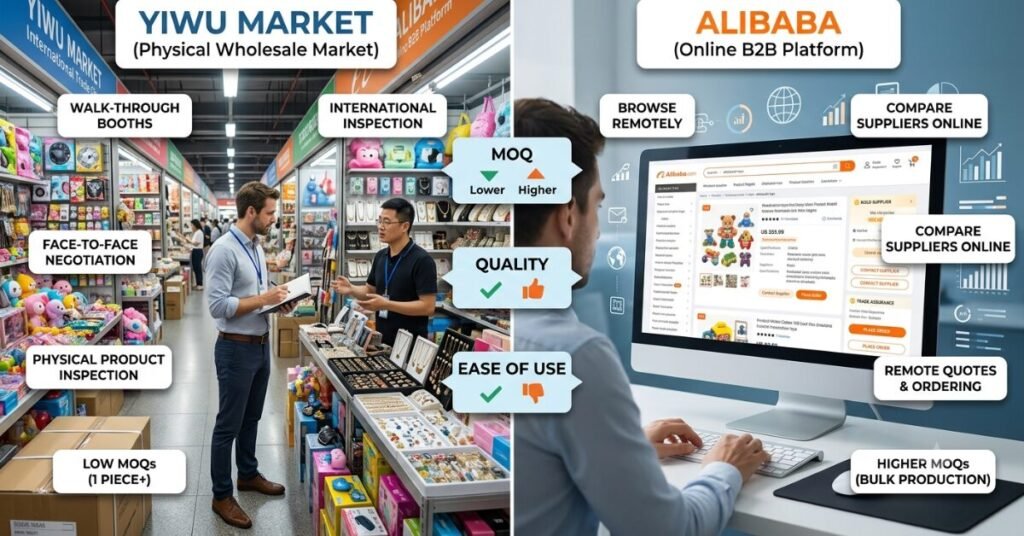
Yiwu Market vs Alibaba is one of the most common decisions importers face when sourcing products from China. Importers around the world rely on both, but the two work in completely different ways. Yiwu is a physical wholesale market where buyers walk through thousands of booths and meet suppliers face to face. Alibaba is an online platform where buyers browse listings, contact suppliers remotely, and place orders without ever leaving their office. Choosing between Yiwu Market vs Alibaba comes down to several factors, including your order size, budget, product type, and how you prefer to manage your sourcing process. This guide acts as a Yiwu Market sourcing guide so you can make a clear, informed decision.
What Is Yiwu Market?
Yiwu Market is the world’s largest physical wholesale market in China, where buyers source products directly from suppliers across thousands of booths. Located in Yiwu City, Zhejiang Province, the market spans millions of square meters and covers almost every consumer product category imaginable. Buyers travel to Yiwu, walk through dedicated districts, and negotiate directly with suppliers on price, MOQ, and product customization. The direct interaction gives buyers an immediate feel for product quality before placing any order. For many importers, this is the main reason Yiwu Market vs Alibaba feels like such a different sourcing decision.
Key Features
Yiwu Market operates differently from any online sourcing platform.
- Yiwu Market is a physical sourcing location based in Yiwu, China.
- Buyers can interact directly with suppliers and inspect products on the spot.
- Minimum order quantities are often low, making it accessible for small buyers.
- The market covers a wide range of product categories under one location.
- This is a major reason why Alibaba vs Yiwu for importers often depends on flexibility.
What Is Alibaba?
Alibaba is an online B2B marketplace that connects global buyers with Chinese manufacturers and trading companies for wholesale sourcing. Buyers can search for any product, compare multiple suppliers, request quotes, and place orders entirely online without traveling to China. Alibaba serves buyers of all sizes, from small businesses testing a new product to large importers managing high-volume factory orders. In any Yiwu vs Alibaba sourcing comparison, Alibaba usually appeals to buyers who want convenience and remote ordering.
Key Features
Alibaba’s platform is built around online accessibility and buyer protection tools.
- Alibaba operates as a fully online sourcing platform accessible from anywhere in the world.
- The platform lists both factory manufacturers and trading companies.
- Buyers can access suppliers globally without any travel requirements.
- Alibaba’s Trade Assurance system provides payment protection for qualifying orders.
- These features shape the Alibaba sourcing vs Yiwu Market differences clearly.
Key Comparison
Yiwu Market vs Alibaba is better for small MOQ sourcing and product variety, while Alibaba is better for factory-scale production and online convenience. Both channels serve different buyer profiles, and the right choice depends on the size of your order, your product requirements, and how much control you want over the sourcing process. This is why many buyers search for Yiwu Market vs Alibaba which is better, before making a decision.
| Factor | Yiwu Market | Alibaba |
| MOQ | Low, often starts at 1 piece | Varies, often higher for factory orders |
| Quality | Inspect on-site before purchase | Depends on supplier; sample required |
| Ease of Use | Requires physical presence or an agent | Fully accessible online |
| Shipping | Requires consolidation and a freight agent | Many suppliers offer export-ready shipping |
| Price | Very competitive at small volumes | Competitive at high volumes |
Looking for expert support to source from Yiwu or Alibaba? Connect with a professional sourcing agent who can handle verification, negotiation, and logistics on your behalf.
Risks of the Yiwu Market vs Alibaba
Both sourcing channels carry real risks that buyers need to understand before committing to any order. Neither Yiwu Market nor Alibaba eliminates sourcing risk, and approaching either without proper due diligence can lead to quality issues, financial losses, or supply chain delays. A careful Yiwu Market sourcing guide should always include risk management.
Yiwu Market Risks
Yiwu Market has specific risks that buyers should prepare for before visiting or sourcing remotely.
- Supplier quality and consistency can vary significantly between booths.
- Buyers need independent product inspection before shipping any bulk order.
- Language barriers make communication difficult without a local agent or interpreter.
- These issues are part of the practical Alibaba sourcing vs Yiwu Market differences.
Alibaba Risks
Alibaba’s online environment creates its own set of sourcing challenges.
- Some listings misrepresent trading companies as direct factories.
- Buyers may deal with intermediaries who add hidden markups to factory prices.
- The quality of bulk orders sometimes differs significantly from approved samples.
- These concerns matter in any Yiwu vs Alibaba sourcing comparison.
Which is Better for Different Buyers?
Yiwu Market vs Alibaba is better for small buyers and mixed sourcing, while Alibaba is better for bulk manufacturing and long-term production. The right platform depends entirely on what you are buying, how much you need, and what stage your business is at. New importers testing a product idea have different needs from established businesses placing repeat factory orders. This is the core question behind Alibaba vs Yiwu for importers.
Choose Yiwu Market If You Want
Yiwu Market suits buyers who prioritize flexibility and direct product access.
- Yiwu Market works best for buyers who need low MOQ sourcing without large commitments.
- Buyers looking for a wide range of product categories in one place benefit from Yiwu.
- Importers who need fast physical sampling before committing to bulk orders find Yiwu more efficient.
- This is why many people use a Yiwu city guide first.
Ready to source from Yiwu Market or Alibaba without the risk? Get in touch with Kingsler today and let a professional sourcing team handle the process from supplier to shipment.
Choose Alibaba If You Want
Alibaba suits buyers focused on volume, customization, and ongoing factory relationships.
- Alibaba is the right choice for buyers placing large bulk production orders.
- Buyers who need OEM manufacturing with custom specifications should use Alibaba.
- Importers building long-term supplier contracts benefit from Alibaba’s platform tools.
- In many cases, this is the stronger side of the Yiwu Market vs Alibaba which is better question.
Smart Strategy to Source from Yiwu and Alibaba Effectively
Using only one platform limits your sourcing options. The most effective importers combine both channels to get the best outcome at each stage of their business. A balanced Yiwu vs Alibaba sourcing comparison often shows that each channel works best at a different stage.
- Use Yiwu Market to test new products at low MOQ before committing to large orders.
- Use Alibaba to scale production once a product is validated and demand is confirmed.
- Combine both platforms to build a balanced sourcing strategy that controls cost and reduces risk.
- This hybrid approach works well for Alibaba vs Yiwu for importers.
How Kingsler Helps With Yiwu and Alibaba Sourcing
Kingsler helps importers source products from Yiwu Market and Alibaba by providing supplier verification, price negotiation, quality inspection, consolidation services, and end-to-end logistics support. Navigating either channel alone carries real risk, and having a local expert on the ground in China removes most of that risk before it reaches your supply chain. Kingsler is especially useful when buyers need a practical Yiwu Market sourcing guide with local execution.
Kingsler’s supplier verification service checks every supplier’s credentials, business registration, and factory status before any payment changes hands. This step filters out trading companies posing as factories and confirms that the supplier can actually deliver what they promise. Price negotiation is handled in Chinese directly with suppliers, which consistently produces better results than buyers negotiating through translation tools remotely.
Quality inspection is conducted before any shipment leaves China. Kingsler’s inspection team visits the factory or warehouse, checks goods against approved samples, and flags any issues before your order ships. This step alone prevents the most common and costly sourcing mistakes. Logistics support covers everything from domestic freight within China to international shipping arrangements, including consolidation for buyers sourcing from multiple Yiwu suppliers in a single trip. That support can make Alibaba sourcing vs Yiwu Market differences easier to manage in practice.
Final Thought
Yiwu Market vs Alibaba is the stronger option for low MOQ sourcing and product variety, particularly for buyers who want direct access to a wide range of products without large order commitments. Alibaba is the stronger option for factory sourcing at scale, with better tools for OEM production, bulk orders, and long-term supplier management. The best approach for most importers is a hybrid sourcing strategy that uses Yiwu to test and sample products and Alibaba to scale what works. Building a process around both platforms gives importers more flexibility, better pricing at each stage, and a stronger overall supply chain. That is the practical answer to Yiwu Market vs Alibaba which is better?
Want help building your sourcing strategy across both channels? Contact Kingsler to start sourcing smarter from China today.
FAQs
Which is cheaper: Yiwu Market or Alibaba?
Yiwu Market tends to offer lower prices at small order quantities because suppliers at the market cater to domestic and small-volume buyers. Alibaba becomes more price-competitive at higher volumes, where factory-direct pricing kicks in. For small orders, Yiwu typically wins on unit cost. For large bulk orders, Alibaba factories often offer better pricing per unit.
Is Yiwu Market better than Alibaba?
Neither is universally better. Yiwu Market is better for low MOQ sourcing, product variety, and direct product inspection. Alibaba is better for bulk production, OEM customization, and remote sourcing. The right choice depends on your order size, product type, and sourcing goals.
Can Alibaba replace Yiwu Market?
Alibaba cannot fully replace the Yiwu Market. Yiwu offers direct supplier interaction, on-site product inspection, and very low MOQ sourcing that Alibaba’s online environment does not replicate. Both platforms serve different sourcing needs, and experienced importers often use both rather than choosing one.
What is the MOQ difference between Yiwu and Alibaba?
Yiwu Market generally has lower MOQs, often starting from a single piece or a small mixed lot. Alibaba MOQs vary by supplier but tend to be higher for factory orders, especially for customized or OEM products.
Which is safer for sourcing from China?
Both channels carry risk, but they carry different types of risk. Yiwu Market requires physical presence or a trusted local agent to manage supplier interaction and product inspection. Alibaba requires careful supplier vetting to identify real factories and avoid trading company markups. Using a professional sourcing agent for either channel significantly reduces the risk for both new and experienced importers.